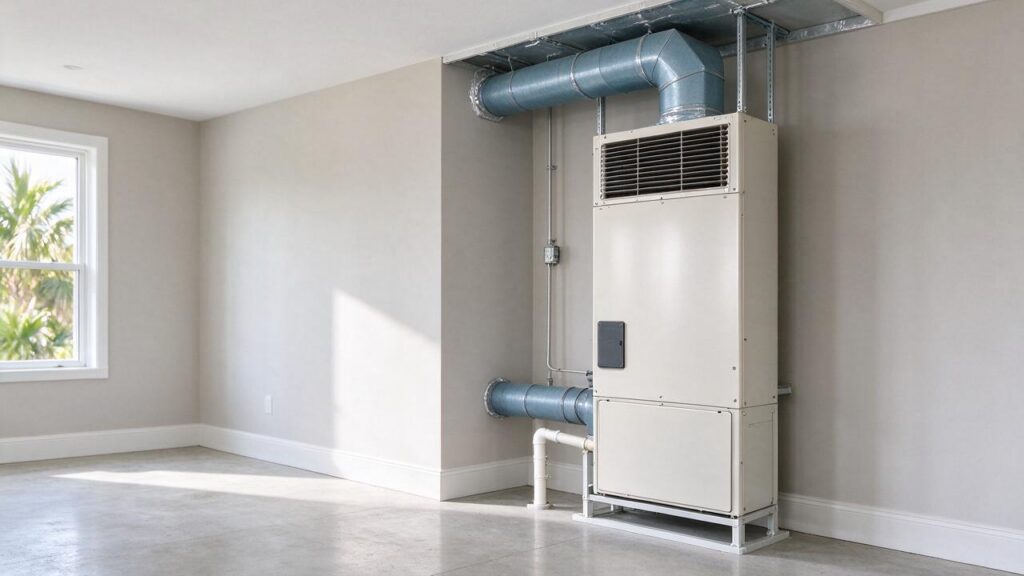
An air handler that isn’t turning on can have several causes, from a simple power interruption to an internal part failure. The symptom alone does not tell you which one applies. What you can do safely is stop guessing, make a few no-tool observations, and then decide whether to request qualified service. A technician, not a homeowner, must confirm the actual fault before any repair decision is made.
This guide walks through that sequence: what the symptom means, what is safe to check, what changes the answer, and what a qualified technician will measure before any repair or replacement decision.
What “Air Handler Not Turning On” Means
The air handler is the indoor part of your cooling system. It moves air across the indoor coil and through your ducts. That is what delivers cooled air into your rooms. When it does not turn on, you may notice weak or no airflow from the vents. You may see the thermostat calling for cooling with no response. Or the outdoor unit may run while nothing happens indoors.
This symptom matters for two reasons. First, your home will not cool well. In Florida’s hot climate, indoor conditions can turn uncomfortable fast. Second, an air handler that stays off while the rest of the system runs can leave parts of the cooling system working under strain. That is why the safe path is to stop using the system for cooling and get it checked rather than keep running it.
One key boundary: “not turning on” is an observation, not a diagnosis. Several different faults can produce the same visible result. Only measurements by a qualified technician can tell them apart.
Safe Observations You Can Make First
You do not need tools, and you should not open any panels. These observations are safe and will help whoever services the system:
- Check the thermostat. Confirm it is set to cool, has power, and shows a setpoint below the current room temperature.
- Check for power interruptions. Look at whether a breaker appears tripped in your electrical panel. Note it, but do not keep resetting a breaker that keeps tripping.
- Check the air filter. A badly clogged filter is a maintenance issue covered in ENERGY STAR’s homeowner maintenance guidance. It is one of the few items a homeowner can address without opening equipment.
- Listen and look. Note whether the indoor unit is fully silent, whether you hear clicking or humming with no airflow, and whether you see water where it should not be.
- Note recent events. A storm, a power outage, or recent work near the equipment can be useful context for the technician.
Write down what you observe. These notes are facts. They are not conclusions about which part failed.
Stop and request qualified help right away if you notice smoke, a smell of electrical burning, repeated breaker trips, water touching electrical parts, severe or odd noise, or an outdoor fan that is not spinning. Do not keep running the system in any of these conditions.
What Changes the Next Decision
The right next step is not the same in every case. Several conditions change the path:
- Safety stop signs. Any warning condition above means shut the system down and request service. No further troubleshooting.
- Simple, fixable conditions. If the only finding is a clogged filter or a thermostat set wrong, fixing that may restore normal operation. If the air handler still will not run after that, service is next.
- System age and repair history. A system with a long record of repairs leads to a different talk than a first-time fault on newer equipment.
- Whether cooling is needed now. In Florida’s cooling season, a non-running air handler usually cannot wait long. But the urgency depends on your actual indoor conditions, not a fixed rule.
What should not be assumed from the symptom alone? Do not assume a specific part has failed. Do not assume a repair will be cheap or costly, or that the whole system must be replaced. None of those calls can be made without measurements.
What a Qualified Technician Evaluates
Diagnosis takes instruments, training, and access to parts of the system a homeowner should never open. A qualified technician will typically verify power and controls, inspect the blower and related parts, check drains and the indoor coil as part of the maintenance limits described by ENERGY STAR, and measure electrical values inside the equipment. If refrigerant work turns out to be needed, EPA-certified refrigerant handling practices apply.
Homeowners should never open energized equipment, test capacitors, bypass safety controls, or handle refrigerant. Those steps are where real diagnosis happens, and they are not safe do-it-yourself work.
From Findings to Decision: Repair, Maintenance, or Replacement
Once the technician has measured the system, the findings point to one of three paths:
- Maintenance correction. If the cause is airflow restriction from a neglected filter, or a drain or coil issue within routine maintenance scope, a maintenance visit may resolve it. Regular filter care is part of the routine the U.S. Department of Energy and ENERGY STAR both describe for keeping cooling systems running as designed. Ongoing care falls under air conditioning maintenance.
- Repair. If a specific part has failed and the rest of the system is in sound shape, a targeted repair is often the right path. When manufacturer warranty coverage is still active, warranty-aware repair practices apply. Warranty terms and registrations vary by equipment and documentation. Repair work falls under air conditioning repair.
- Replacement conversation. If the findings show heavy wear, repeated failures, or a fault where repair does not make sense given the system’s condition, replacement becomes the evidence-based discussion. That call should rest on measured findings, not on the single symptom of an air handler that would not start.
If you do request service, Velocity offers 24/7 repair availability, and same-day dispatch may be available when a technician is free. Velocity states that it does not add a separate night or weekend service charge, so an evening or weekend call does not carry a premium fee by that policy. You can request service once your notes are ready.
Prepare Before You Call
A short checklist makes the visit more useful:
- Your notes on what the air handler is or isn’t doing, and when you first noticed it
- Thermostat settings and whether any breaker appeared tripped
- Whether the filter was changed recently and its rough condition
- Any recent storm, outage, or work near the equipment
- Equipment details the technician may ask for, such as what you can read on the unit’s label without opening anything
Frequently Asked Questions
How do I know whether an air handler not turning on needs service?
If the air handler stays silent or unresponsive after you have confirmed the thermostat settings and filter condition, service is the right next step. If you see smoke, smell electrical burning, see repeated breaker trips, notice unsafe water contact, hear severe noise, or see a non-spinning outdoor fan, stop the system and request qualified help right away rather than waiting.
What information should I gather before calling?
Collect only safe observations: thermostat settings, whether a breaker appeared tripped, filter condition, what you hear or don’t hear, when the symptom started, and any recent outage or storm. Do not open panels or try electrical tests. These notes help the technician diagnose faster without you taking any risk.
Can a homeowner safely fix an air handler that isn’t turning on?
Only a few items are homeowner-safe, such as correcting thermostat settings or replacing a clogged filter. Everything else, including opening panels, testing electrical parts, or handling refrigerant, requires a qualified HVAC technician. The symptom alone does not identify the failed part, so do-it-yourself repair attempts based on guessing are both unsafe and unreliable.
What does a technician check for an air handler not turning on?
A qualified technician verifies power and controls, inspects the blower and related parts, checks drains and the indoor coil, and takes electrical measurements inside the equipment. If refrigerant work is needed, EPA-certified refrigerant handling practices apply. These measurements, not the symptom, determine the actual diagnosis.
When does an air handler not turning on become a repair-versus-replacement talk?
That talk begins when the technician’s measured findings show more than a single fixable fault, such as heavy wear, repeated failures, or a condition where repair does not make sense given the equipment’s overall state. The decision follows the evidence gathered during diagnosis, not the symptom itself.