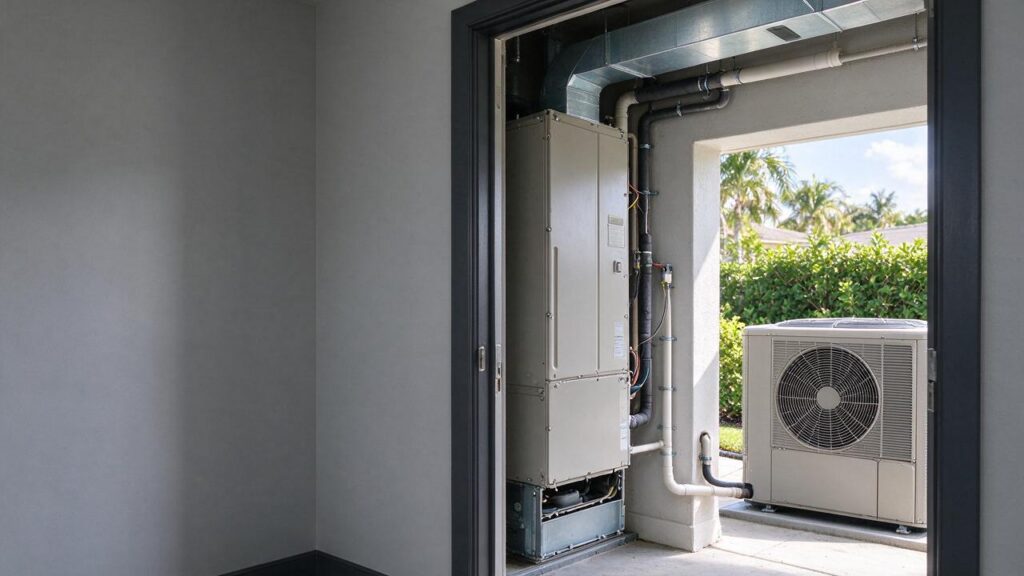
An air handler in the attic is an equipment location, not a diagnosis. Having this unit overhead creates specific service considerations — harder access, less visible leaks, and conditions that differ from a closet or garage install. But the location alone does not tell you what is wrong. Safe observations you make from outside the unit can help describe the situation. A qualified HVAC technician must measure system performance before any repair, maintenance, or replacement decision is made.
What an Air Handler in the Attic Means
The air handler is the indoor part of a cooling system. It holds the blower that moves air across the coil and through your ducts. In many Florida homes, the unit sits in the attic to save living space. In a hot climate, cooling runs for long seasons, so the air handler works hard. Its location affects how problems show up.
Keep two things separate. One is the location fact: the unit is in the attic. The other is the performance facts: whether it cools well, drains well, and runs safely. The location can hide early signs of trouble. That is why careful observation matters. The location itself is not a fault.
Safe Observations You Can Make
You can gather useful information without opening panels or touching electrical parts. Do not climb into tight attic spaces. From safe vantage points, note:
- Sounds: new rattling, grinding, or scraping when the system starts or runs.
- Visible water: ceiling stains below the unit, drips at the access panel, or water in the drain pan if safely visible.
- Filter condition: a heavily loaded filter, if the slot is reachable without entering the attic.
- Airflow at the registers: rooms with weak or uneven airflow compared to normal.
- Insulation and access: areas near the unit that look wet, disturbed, or blocked, if you can see them safely.
Write down what you see and when. These notes help a technician narrow the possibilities. Do not open the unit, test electrical parts, or clear a drain line inside the cabinet.
Safety Stop Signs: When to Stop and Call for Help
Some conditions should end troubleshooting right away. Stop the system and request qualified help if you notice:
- Smoke or a smell of electrical burning
- Repeated breaker trips when the system starts
- Water touching electrical equipment or unsafe standing water near the unit
- Severe or sudden loud noise during operation
- An outdoor fan that is not spinning while the system runs
These signs can point to hazards. They call for professional evaluation, not homeowner fixes.
What Changes the Answer
The right next step depends on facts a symptom alone cannot show. Factors that shift the decision include:
- System age and repair history: a unit with past repairs may point to a different choice than a newer system with a first-time issue.
- Water history: a past or current leak in an attic can affect what needs checking beyond the symptom.
- Efficiency goals: if lower operating cost matters to you, that changes how options are weighed.
- Access and install condition: attic placement affects how easily the unit can be serviced.
Until a technician measures the system, treat every possible cause as a possibility. That includes a drain issue, a blower problem, a duct restriction, or a control fault. None is confirmed from a symptom alone.
What a Qualified Technician Evaluates
A technician’s visit turns observations into evidence. Typical checks include measuring system performance, checking the blower and controls, inspecting the drain and pan, examining the coil, and confirming safe electrical operation. When refrigerant work is involved, EPA-certified handling practices apply. When manufacturer coverage is still active, warranty-aware repair practices apply. Warranty terms vary by equipment and documentation.
This is why a symptom alone cannot produce a diagnosis. The same sign — weak airflow, for example — can have several causes. Only measurements can tell them apart.
Observation vs. Diagnosis vs. Decision
| Stage | Who does it | What it produces |
|---|---|---|
| Observation | Homeowner | Safe notes on sounds, water, airflow, and filter condition |
| Diagnosis | Qualified technician | Measured performance and a confirmed cause |
| Decision | Homeowner with technician input | A maintenance, repair, or replacement path based on evidence |
Use the technician’s findings to weigh three paths. If the finding points to a maintenance gap — a loaded filter or a drain that needs cleaning — scheduled air conditioning maintenance may be the right step. If the finding confirms a failed part, a targeted air conditioning repair conversation follows. If the evidence shows declining performance across several parts, or a pattern of repeat repairs, the measurements become the basis for a repair-versus-replacement comparison. Ask for the findings in writing so you can compare options against your priorities.
Preparing for the Call
Before you request service, have this short list ready:
- What you observed, when it started, and whether it is constant or intermittent
- Any water history near the unit or ceiling stains below it
- Filter condition and the last time it was changed, if known
- Whether any safety stop signs occurred
When you are ready for professional evaluation, you can request service. Velocity offers 24/7 repair availability. Same-day dispatch may be available when a technician is available. Velocity states that it does not add a separate night or weekend service charge.
Focused FAQs
How do I know whether an air handler in the attic needs service?
Look for changes from normal operation: new noises, weak or uneven airflow, visible water or ceiling stains, or a heavily loaded filter. Any of these is a reason to have the system evaluated. Safety stop signs — smoke, burning smell, repeated breaker trips, severe noise, or a non-spinning outdoor fan — mean stop the system and request qualified help right away.
What information should I gather before calling?
Note what you saw and when it started. Say whether the problem is constant or intermittent. Add any water history near the unit, the filter condition, and whether any safety stop signs occurred. These safe observations help the technician diagnose faster without you opening any panels.
Can a homeowner safely fix an attic air handler?
Homeowners can safely observe and describe the situation. Keep the filter changed where the slot is reachable. Do not open energized equipment, test capacitors, bypass safety controls, or handle refrigerant. Diagnosis and repair require a qualified HVAC technician with the right tools and certifications.
What does a technician check for an attic air handler?
A technician measures system performance, checks the blower and controls, inspects the drain and pan, examines the coil, and confirms safe electrical operation. If refrigerant work is needed, EPA-certified handling practices apply. Warranty-aware practices are used when manufacturer coverage remains active.
When does an attic air handler become a repair-versus-replacement conversation?
That talk is appropriate when verified evidence — not a single symptom — supports it. Examples include findings of declining performance across several parts or a pattern of repeat repairs. Your technician’s written measurements, plus your system’s age, repair history, and efficiency goals, form the basis for comparing the two paths.