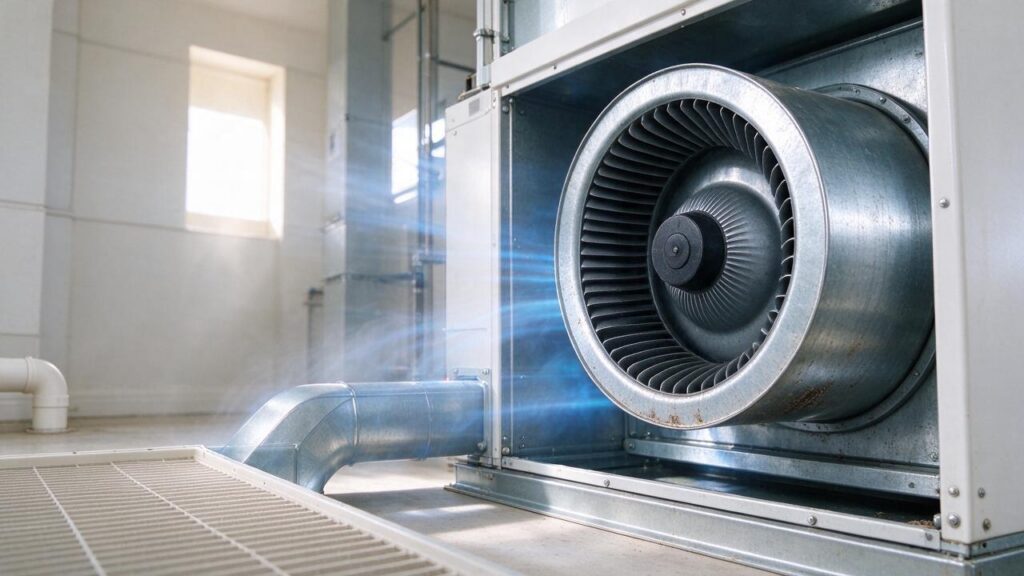
Air duct cleaning is a service decision, not a diagnosis. Cleaning ducts can help when dust or debris is actually restricting airflow. But weak cooling, uneven rooms, or dirty vents can also come from a clogged filter, blocked registers, or an equipment problem that cleaning will not fix. The right first step is to make a few safe observations. Then have a qualified HVAC technician measure how your system is performing before you commit to any service.
What Air Duct Cleaning Means in Practical Terms
In practical terms, air duct cleaning means having the supply and return ductwork, and often the blower compartment area, inspected and cleaned of built-up dust and debris. For a cooling system, the goal is restoring normal airflow so conditioned air reaches each room as designed.
It is not, by itself, a fix for every cooling complaint. The U.S. Department of Energy’s cooling guidance describes a cooling cycle that depends on the whole system working together. Refrigerant-side parts, the blower, the filter, and the ductwork all carry a share of the job. If any one of those parts underperforms, symptoms can look similar from inside the house. That is why “air duct cleaning” should be treated as one possible answer, not the automatic one.
How Airflow Affects Cooling
Your air conditioner removes heat from indoor air and sends it back through the supply ducts. When airflow drops, cooling suffers in ways that are easy to feel but hard to diagnose from the couch:
- Reduced delivery. Air that cannot move freely through ducts, filters, or vents cools rooms less effectively.
- Uneven temperatures. Rooms farthest from the air handler often show problems first when airflow is restricted.
- Longer run times. A system moving less air may run longer to reach the same temperature. That pattern is worth noting, but it is not a diagnosis by itself.
ENERGY STAR’s maintenance checklist places filters, drains, coils, controls, and blower checks on both the homeowner and professional sides of maintenance. That split matters here. Some airflow causes are simple maintenance items. Others require measurements only a technician can take.
Symptom Differences That Change the Decision
Before deciding anything, separate what you can safely observe from what you should not conclude. Three distinctions matter most:
- Filter or vent restriction versus an equipment issue. A loaded filter or closed, blocked, or dusty registers can mimic deeper problems. These are the simplest possibilities to rule out safely.
- An air-distribution issue versus a cooling-capacity issue. If air is moving but not cold enough, or the system runs constantly without cooling, the ducts may not be the cause at all. Capacity problems involve refrigerant-side and equipment performance that a technician must evaluate.
- Safe maintenance versus repair work. Replacing a filter and clearing registers is homeowner territory. Anything involving opening panels, electrical parts, capacitors, or refrigerant is not.
Carrier’s guidance on outdoor-fan problems stresses the same boundary from the equipment side. Possible causes such as capacitor or motor issues exist, but electrical-safety limits apply. A non-spinning outdoor fan is a stop-and-call situation, not a do-it-yourself project.
Safe Homeowner Checks Before Calling
These observations are safe, useful, and take only a few minutes. They also give a technician better information if you do call.
- Check the filter. Note whether it is visibly loaded with dust and when it was last changed. A restricted filter is one of the most common causes of weak airflow.
- Walk the vents. Look for supply registers that are closed, blocked by furniture or rugs, or heavily dusty. Note which rooms feel weakest.
- Look at visible return grilles. Heavy dust or debris at returns is an observation worth recording. It is a clue, not a confirmed diagnosis.
- Note the pattern. Write down when the problem started, which rooms are worst, and whether the system runs longer than usual.
- Check the thermostat. Confirm the system is in cooling mode with a reasonable setpoint before assuming a fault.
Stop and request qualified help right away if you notice smoke, an electrical burning smell, repeated breaker trips, unsafe water contact with equipment, severe or sudden noise, or an outdoor fan that is not spinning. These are safety stop signs, not airflow observations.
What a Qualified Technician Measures
A diagnosis requires measurements, not labels. When a technician evaluates an airflow or duct concern, the check typically includes:
- Airflow and static pressure checks to see whether air is moving as designed through the filter, blower, and duct system.
- Filter, blower, and coil condition to find restrictions on the air side of the system, consistent with the professional maintenance boundaries ENERGY STAR describes.
- Temperature split and cooling performance to tell an air-distribution problem apart from a cooling-capacity problem.
- Refrigerant-side evaluation when needed. Any refrigerant work must follow EPA-certified refrigerant handling practices, and repairs are done with warranty-aware practices when manufacturer coverage remains active.
- Duct condition review to decide whether cleaning, sealing, or another action is the right response.
Only after this kind of measurement does “air duct cleaning” become a confirmed recommendation rather than a guess. If the evidence points to a failed component instead, air conditioning repair is the appropriate path. Velocity offers 24/7 repair availability, with same-day dispatch possible when a technician is available. Velocity states that it does not add a separate night or weekend service charge.
Maintenance and Prevention
Staying ahead of airflow problems is mostly about the simple items:
- Replace or clean filters on the schedule your system and filter type call for, and sooner if they load up quickly.
- Keep supply registers and return grilles unblocked and reasonably dust-free.
- Schedule professional air conditioning maintenance so coils, drains, controls, and blower parts are checked by someone qualified, following the homeowner-versus-professional split ENERGY STAR outlines.
Florida’s cooling demand means long run seasons for most households. That is exactly why small airflow restrictions show up as noticeable comfort problems. Even so, no two buildings have identical duct layouts, insulation, humidity exposure, or equipment. Avoid assuming that what helped a neighbor will be the right answer for your home.
Quick Decision Map
| What you observe | Possible meaning | Safe next step |
|---|---|---|
| Weak airflow at vents, dirty filter | Possible filter restriction | Replace filter; recheck airflow |
| Weak airflow, clean filter, clear vents | Possible duct, blower, or coil restriction | Schedule a technician evaluation |
| Air flows but is not cold enough | Possible cooling-capacity issue | Request professional diagnosis; do not open equipment |
| Heavy visible dust at returns | Possible duct buildup, unconfirmed | Record observation; include it when you call |
| Burning smell, smoke, breaker trips, non-spinning outdoor fan | Safety stop sign | Stop the system and request qualified help now |
Focused FAQs
How do I know whether air duct cleaning is needed?
You do not decide from the symptom alone. Start with the safe checks above: filter condition, vent blockages, and visible dust at returns. If weak airflow persists after those basics are addressed, a technician’s airflow and static pressure measurements show whether ducts are actually the restriction or whether the cause is elsewhere.
What should I gather before calling about air duct cleaning?
Collect only safe facts: when the problem started, which rooms are weakest, filter age and condition, any visible dust or debris at grilles, and the run-time pattern. Note any safety symptoms separately, such as burning smells or breaker trips, and report those first when you call.
Can a homeowner safely handle air duct cleaning?
A homeowner can safely replace a filter, clear blocked registers, and dust grilles. A homeowner should not open energized equipment, test capacitors, bypass safety controls, or handle refrigerant. Anything beyond filters and vents belongs with a qualified technician.
What does a technician check for air duct cleaning?
A technician verifies airflow and static pressure, inspects the filter, blower, and coils, measures cooling performance to separate distribution from capacity problems, and reviews duct condition. If refrigerant work is needed, it is done under EPA-certified refrigerant handling practices, with warranty-aware repair practices when coverage is active.
When does air duct cleaning become a repair-versus-replacement question?
That shift happens only after measurement. If airflow checks and cooling tests point to restricted ducts, cleaning may be the right scope. If they point to a failing component or broader equipment decline, the conversation becomes repair or replacement, based on what the technician’s findings show.
Choosing the Next Step
Air duct cleaning is a reasonable question to ask. But it is the conclusion to a diagnostic process, not the start of one. Make the safe observations, rule out the simple restrictions, and let measured evidence decide the scope of work. If you want a professional evaluation, request service and share what you observed, including any safety symptoms, so the right technician and the right diagnostic sequence arrive at your door.