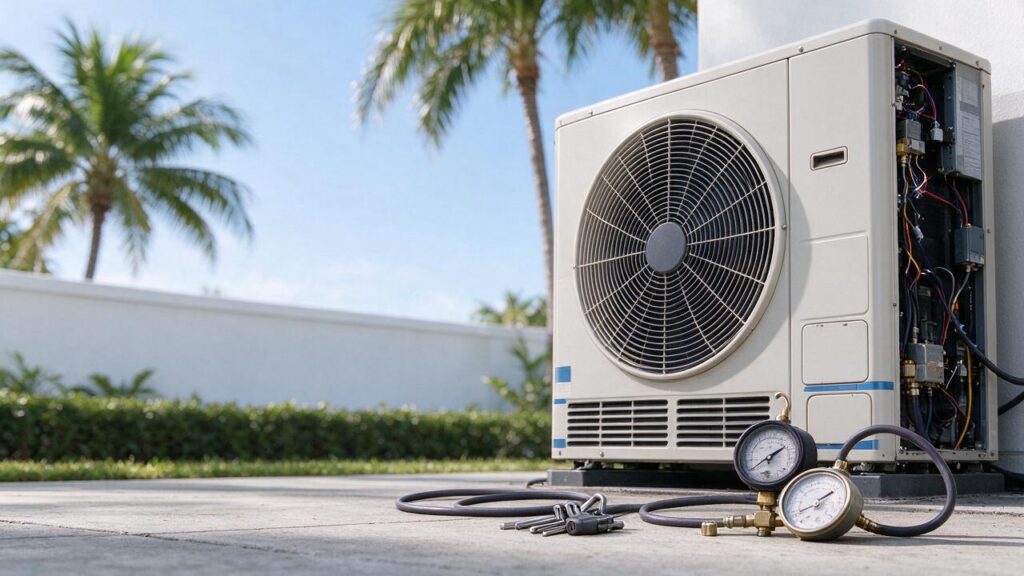
Ac tips for Florida summer are practical steps that help your cooling system handle long, hot run times. They are observations and habits, not diagnoses. A system that blows warm air, cycles on and off fast, or struggles to keep up may have more than one cause. Some causes are safe for a homeowner to check. Others need a qualified HVAC technician with the right tools and certifications. This guide separates the two so you can pick a safe next step.
What “AC Tips for Florida Summer” Means in Practice
This topic covers two things. First, the routine care that keeps a cooling system working through heavy summer use. Second, the observations you can make when something seems wrong. Florida’s cooling season puts sustained demand on air conditioning equipment. That is why maintenance and early observation matter here. Even so, cooling demand varies by building, system, and conditions. No two homes have identical loads, ductwork, or equipment.
The U.S. Department of Energy’s home cooling guidance stresses cooling-cycle basics and regular maintenance as the base of reliable operation. ENERGY STAR’s maintenance checklist draws a clear line. Homeowners can handle filters, drains, and visual checks. Professionals handle coil, control, and blower work. This page follows that same boundary.
Safe Observations Any Homeowner Can Make
Before requesting service, you can safely collect facts that will help a technician. None of these involve opening equipment, testing electrical parts, or handling refrigerant.
- Check the filter. A clogged filter restricts airflow. It is one of the most common and easily fixed issues. Note the filter size and how long it has been in place.
- Look at the thermostat. Confirm the system is set to cool. Check the fan setting and the target temperature. Note whether the reading matches how the room feels.
- Watch the outdoor unit from a distance. Does the fan spin during a cooling call? Is heavy debris or vegetation around the unit? Do you hear odd noise?
- Check for water where it should not be. Look for moisture near the indoor unit or drain line. Do not touch electrical parts.
- Track the pattern. Write down when the problem happens, how long the system runs, and whether rooms cool unevenly. Note if the issue is constant or comes and goes.
These are observations, not conclusions. Warm air or short cycling can have several causes. Only measured testing can confirm which one applies to your system.
Conditions That Change the Next Decision
Some observations should end troubleshooting right away and move you to requesting qualified help.
Stop the system and request qualified help if you notice smoke, an electrical burning smell, repeated breaker trips, unsafe water contact with equipment, severe noise, or an outdoor fan that is not spinning.
Other conditions change the decision without being emergencies:
- A filter loaded with dust points first to filter replacement and a recheck, not a repair call.
- Water near the indoor unit suggests a possible drain issue. It should be checked before it causes more damage.
- Uneven cooling between rooms may relate to airflow, ductwork, or system size. A technician must measure these.
- A system that runs constantly on extreme-heat days may be normal for the conditions, or may signal a problem. Run-time history helps a technician tell the difference.
What a Qualified Technician Must Verify
Several checks require training, tools, and certifications that homeowners should not attempt:
- Refrigerant charge and refrigerant work. EPA-certified handling practices apply whenever refrigerant work is done. Never open the refrigerant circuit yourself.
- Electrical parts and controls. Testing capacitors, contactors, or control boards involves energized equipment. This belongs to a qualified technician.
- Coils and blower condition. ENERGY STAR places coil and blower checks on the professional side of the maintenance boundary.
- Measured airflow and temperature split. Confirming whether the system moves and conditions air correctly takes instruments, not observation alone.
When a technician performs repair work, warranty-aware practices apply if manufacturer coverage is still active. Warranty terms and registration rules vary by equipment and paperwork. Coverage should be confirmed for your specific system, not assumed.
Mapping the Evidence to Your Next Step
Your next step follows from the evidence, not from the symptom alone. Use this decision map:
| What You Observe | Safe Next Step | What a Technician Confirms |
|---|---|---|
| Dirty filter, debris around the outdoor unit | Replace filter; clear debris | Whether airflow has returned to normal |
| Warm air after basic checks | Request service; share your notes | Measured cause—do not assume a failed part |
| Water near indoor equipment | Request service promptly | Drain and moisture condition |
| Repeated breakdowns or aging equipment | Request an evaluation | Repair-versus-replacement evidence |
A repair-versus-replacement talk should be triggered by specific, verified evidence, such as measured system condition and repair history. It should not rest on a symptom or a label alone. An estimator or technician should verify the equipment’s actual condition before recommending either path.
Receipt Notes to Keep After Every Visit
Good records make future service faster and support any warranty review. After each visit, keep these receipt notes:
- Date and company name for the visit, plus the technician’s name if listed.
- What was found in plain terms, such as “dirty filter replaced” or “drain line cleared.”
- What was done, including any parts replaced and the work performed.
- Filter size and change date, so you can repeat the right replacement on schedule.
- Any follow-up advised, such as a recommended maintenance interval or a future check.
Store these notes with your equipment records. A clear history helps a technician compare past findings with current symptoms. It also documents care if a warranty question comes up later. Keep in mind that warranty coverage itself varies by equipment and documentation, so confirm the terms for your system rather than assuming them.
Scheduling Service in Florida
Velocity offers 24/7 repair availability. Same-day dispatch may be available when a technician is free. Velocity states that it does not add a separate night or weekend service charge. Before you call, gather your notes: the symptoms you saw, when they started, your filter’s age, and any patterns you tracked. If you are ready for help, you can request air conditioning repair or schedule routine air conditioning maintenance through the contact page.
Focused FAQs
How do I know if my Florida summer AC problem needs service?
If basic safe checks—filter condition, thermostat settings, and clearing debris around the outdoor unit—do not fix the issue, request qualified service. Also stop and call if you see any safety sign, such as burning smells, repeated breaker trips, or a non-spinning outdoor fan.
What information should I gather before calling?
Note the symptoms, when they started, and whether they are constant or come and go. Add the filter’s age and size, thermostat settings, and anything unusual you saw or heard. This history shortens diagnosis and avoids repeat visits.
Can a homeowner safely fix this alone?
Homeowners can safely replace filters, verify thermostat settings, and keep debris away from the outdoor unit. Anything involving refrigerant, energized electrical parts, coils, the blower, or opening equipment needs a qualified technician.
What does a technician check that I cannot?
A technician measures refrigerant charge under EPA-certified handling practices, tests electrical parts safely, inspects coils and the blower, and verifies airflow and temperature performance with instruments.
When does this become a repair-versus-replacement conversation?
When a technician’s measured findings, such as system condition and repair history, support it. That decision should rest on verified evidence about your specific equipment, not on a single symptom or age alone.